Google quietly made one of its most disruptive changes to search results in September 2025—a technical adjustment that broke long-standing SEO tools, revealed years of inflated reporting, and forced the industry to finally confront which metrics truly matter.
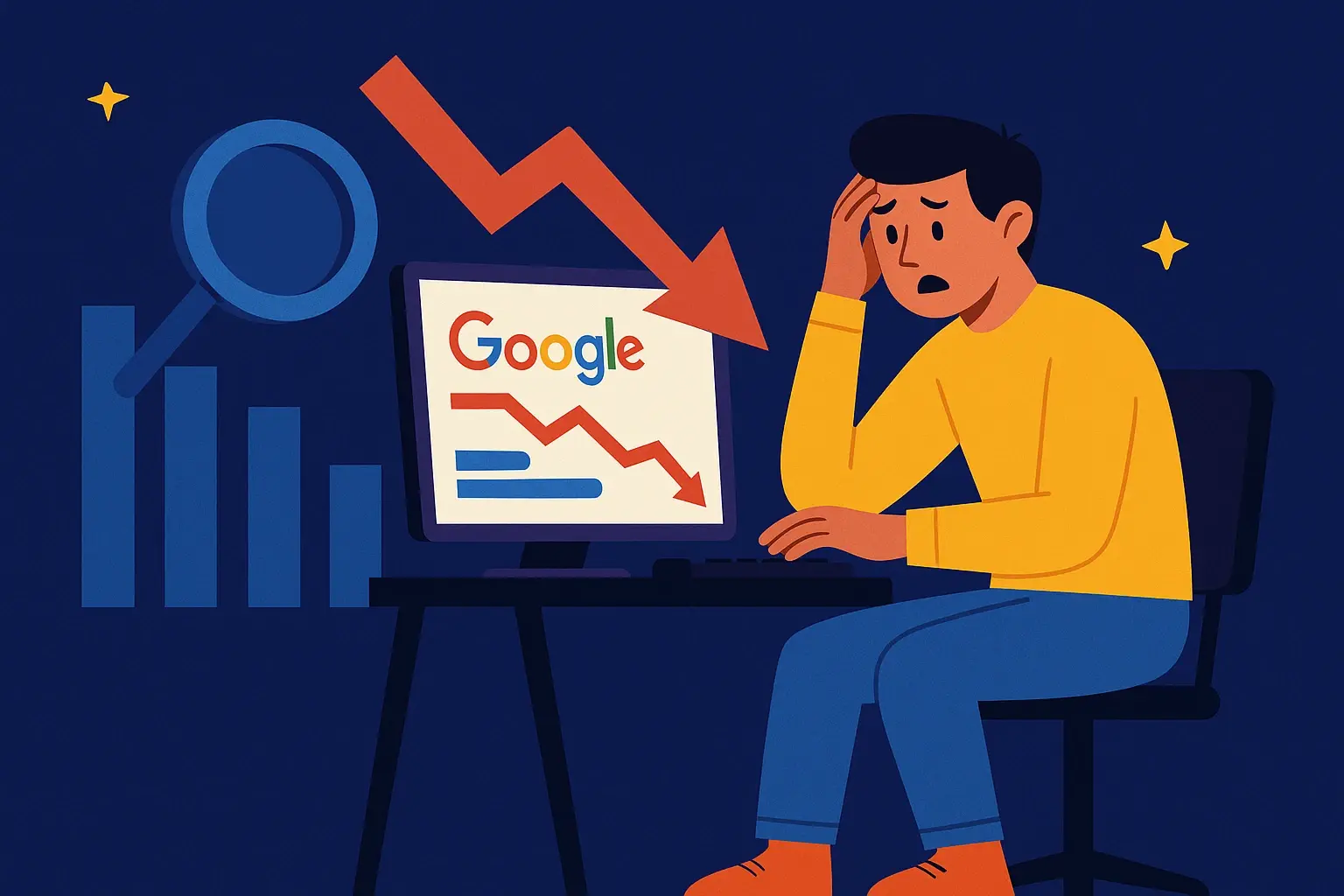
For years, SEO agencies tracked visibility across hundreds of keywords, showing colorful charts filled with “impressions” and “rankings.” But when Google eliminated a key data shortcut, the illusion vanished. Overnight, many companies saw steep drops in Google Search Console impressions and lost visibility in their reports.
Here’s the reality: this change doesn’t mean your brand disappeared from Google’s search results. It means the numbers are finally reflecting what real humans actually see, and that’s a big step forward for anyone serious about marketing outcomes.
Think of it this way: it’s like realizing your Fitbit wasn’t just tracking your steps, but also counting every time you shook your wrist. The data looked great, but it wasn’t real.
The Technical Change: Google Ends the &num=100 Parameter
What Was the &num=100 Parameter?
For over a decade, SEO tools relied on Google’s &num=100 URL parameter. This tiny code let tools like Ahrefs, Semrush, and Moz pull 100 search results in a single request instead of just 10. It was an efficiency shortcut: one call instead of ten.
What Happened in September 2025
Between September 10–12, 2025, Google silently disabled the &num=100 parameter. Now, every request only returns 10 results—the first page. To get 100 results, tools must make ten times the calls, multiplying their server costs by 1,000%.
Why Did Google Do It?
The timing wasn’t random. AI companies were aggressively scraping Google’s search results to train large language models. The &num=100 shortcut made bulk scraping too easy. Google’s move: cut off the loophole.
But this technical adjustment also killed the ability to efficiently track search rankings beyond the first page, shaking up the SEO community.
A Simple Example: Perrier on Google
For anyone who finds this too abstract, let’s make it simple. Imagine you search for “Perrier sparkling water” on Google.
Before (with the &num=100 trick)
SEO tools would grab the first 100 results at once, which is 10 full pages of search engine results pages (SERPs). Each time the bot did this, Google Search Console logged it as if a user had seen those pages. That meant Perrier’s competitors on pages 5, 6, or 7 were getting “impressions”, even though no real person scrolled that far. Reports looked inflated.
Now (after Google removed &num=100)
Only the first page of 10 results gets logged automatically. If a real user actually clicks to page 2, then those results register impressions. In other words, the data now reflects what real humans see, not what bots are loading.
Why Google saw this as a problem
The old system was giving false signals. Analytics showed far more impressions than real users were generating. Add to that the pressure of AI scrapers, and Google decided to shut the door.
Why this matters for companies tracking SEO metrics with Search Console, Ahrefs, or other similar SEO reporting tools:
- Bad news: Past SEO reports look worse in comparison; those big impression numbers weren’t real.
- Good news: Data is now cleaner and more accurate, so marketers can measure what really matters: clicks, leads, and conversions from organic search results.
The Shockwave: Impressions Collapse Across 87.7% of Sites
The removal of &num=100 didn’t just break tools, it exposed years of inflated reporting.
As Search Engine Land reported, 87.7% of websites saw sudden drops in impressions in Google Search Console. Some lost over 200,000 daily desktop impressions overnight.
Why? Because those impressions were never from humans. They were bot-generated whenever SEO tools loaded pages in bulk.
SEO analyst Tyler Gargula examined 319 sites and found that 77.6% also “lost” unique ranking terms in their reports. What many thought was “The Great Decoupling” (AI overviews replacing traditional clicks) turned out to be bot traffic disappearing.
For CMOs and marketing leaders, the key takeaway is this: Your SEO didn’t collapse. Your numbers just became more honest.
How SEO Tools Responded
The SEO tool market scrambled, and their responses reveal who could weather the storm.
- AccuRanker absorbed the cost increase with a hybrid model: daily monitoring of top-30 search rankings and bi-monthly updates for top-100. They promised to hold prices for existing users, even as server costs soared.
- Semrush reassured customers that “top 10 and top 20 results remain fully intact.” But their Sensor tool, used for volatility tracking, stopped updating entirely.
- Ahrefs pivoted philosophically. CMO Tim Soulo argued that positions 21–100 rarely matter, since few users ever reach them. AhrSefs doubled down on page-one tracking, aligning with search intent and business value.
- Smaller SEO platforms like SpyFu vowed to keep deep tracking alive, but face existential threats as their costs multiply.
This divide underscores a bigger truth: traditional rank tracking as we knew it is dead.
Connecting the Change to Google Algorithm Updates
This wasn’t just a technical fix. It ties into Google’s broader push in 2023–2025 to clean up the search landscape.
- 2023 Core Update, August Core Update, November Core Update: tightened the quality signals.
- Spam updates: targeted link spam, expired domain abuse, and site reputation abuse.
- Helpful Content system: rewarded high-quality content and penalized low-quality content or AI-generated fluff.
- AI Overviews (SGE): changed how answers appear directly in Google’s search results, reducing clicks to traditional web pages.
Seen together, the &num=100 removal is part of a long series of Google algorithm updates designed to cut manipulation, reduce spammy links, and improve relevant search results.
Google has consistently said it “aims to help users find relevant answers,” and that means eliminating inflated metrics and low-quality signals.
What This Means for Businesses and Agencies
For business leaders and CMOs, the September change creates both short-term headaches and long-term benefits.
Short-Term: Reporting Pain
- Year-over-year comparisons are broken.
- Month-over-month trends look unreliable.
- Clients are asking: “Why did impressions drop?”
Long-Term: Cleaner, Smarter Data
- Organic search traffic now reflects genuine visibility.
- CTR and average position are more trustworthy.
- Metrics tie closer to brand visibility and conversions.
Cost Implications
- Comprehensive rank tracking is 10x more expensive.
- Many tools will raise prices.
- “Track everything” SEO strategies are no longer financially viable.
The Opportunity for Forward-Thinking Agencies
Agencies that adapt quickly can turn this disruption into a positioning advantage.
Instead of defending broken metrics, progressive agencies are shifting focus to value-based reporting:
- Conversion attribution: connecting SEO to revenue.
- Top-10 market share: measuring meaningful visibility.
- Featured snippets and AI overviews: winning enhanced placements in Google’s evolving SERPs.
- Local business listings and Google Business Profiles: ensuring local search results are optimized.
This is an opportunity to reset expectations with clients and build stronger trust.
Google’s Strategic Motivations
Industry experts agree on four overlapping motives:
- Infrastructure protection: reducing strain from AI scraping and automated queries.
- Data accuracy initiative: cleaning up inflated Search Console metrics.
- Competitive positioning: making it harder for third-party tools, pushing businesses toward Google’s own analytics.
- User experience alignment: forcing SEO strategies to reflect real user behavior.
As Search Engine Journal noted: “Google modifies search results parameter, affecting SEO tools.” This isn’t anti-SEO; it’s Google recalibrating the playing field.
Strategic Recommendations for CMOs and SEO Leaders
- Communicate proactively: explain reporting changes to stakeholders.
- Refocus on page-one SEO strategies: positions 1–20 are where clicks live.
- Audit SEO tools and budgets: expect higher costs, plan accordingly.
- Double down on helpful content: align with Google’s core updates and site reputation abuse policies.
- Leverage local search: optimize your Google Business Profile (when applicable) and local search results for brand visibility.
- Prepare for AI Overviews: adapt SEO strategies for Google’s search generative experience.
Conclusion: The End of Vanity Metrics
The removal of the &num=100 parameter is more than a technical change. It’s a forcing function, pushing SEO beyond vanity metrics and toward genuine business outcomes.
For marketing leaders, the message is clear:
- Don’t panic over lost impressions.
- Embrace cleaner data.
- Focus on clicks, conversions, and organic listings that drive growth.
In the long run, this makes SEO reporting more honest and more valuable. The agencies that thrive will be those that help clients see past the noise and connect SEO directly to brand visibility, leads, and revenue.
References and Sources
Primary Industry Analysis
SEO Tool Company Responses
Industry Impact Analysis
Technical and Cost Analysis
Agency and Business Impact
Additional Technical Resources
Last updated: September 2025


.jpg?width=768&name=keys%20to%20the%20kingdome%20(2).jpg)